By Kokab Rahman, Founder & CEO, Radeya Global
Welcome back to the Weekly News & Updates section on the Radeya Global Blog. Each week we distill the most relevant career and business developments so professionals, entrepreneurs, and job seekers can stay informed and act with clarity.
Here is what mattered this week (September 5–11, 2026).
Labor Market & Jobs
Last week’s U.S. jobs print still set the tone. Employers added 162,000 positions in August and the unemployment rate held at 4.1 percent. That was a clearer rebound than the low-hire stretch earlier in the year — and it was not evenly spread. Healthcare, food service, and parts of local government education carried much of the gain. Wage growth remains real, but it is not outrunning the cost of living in every household.
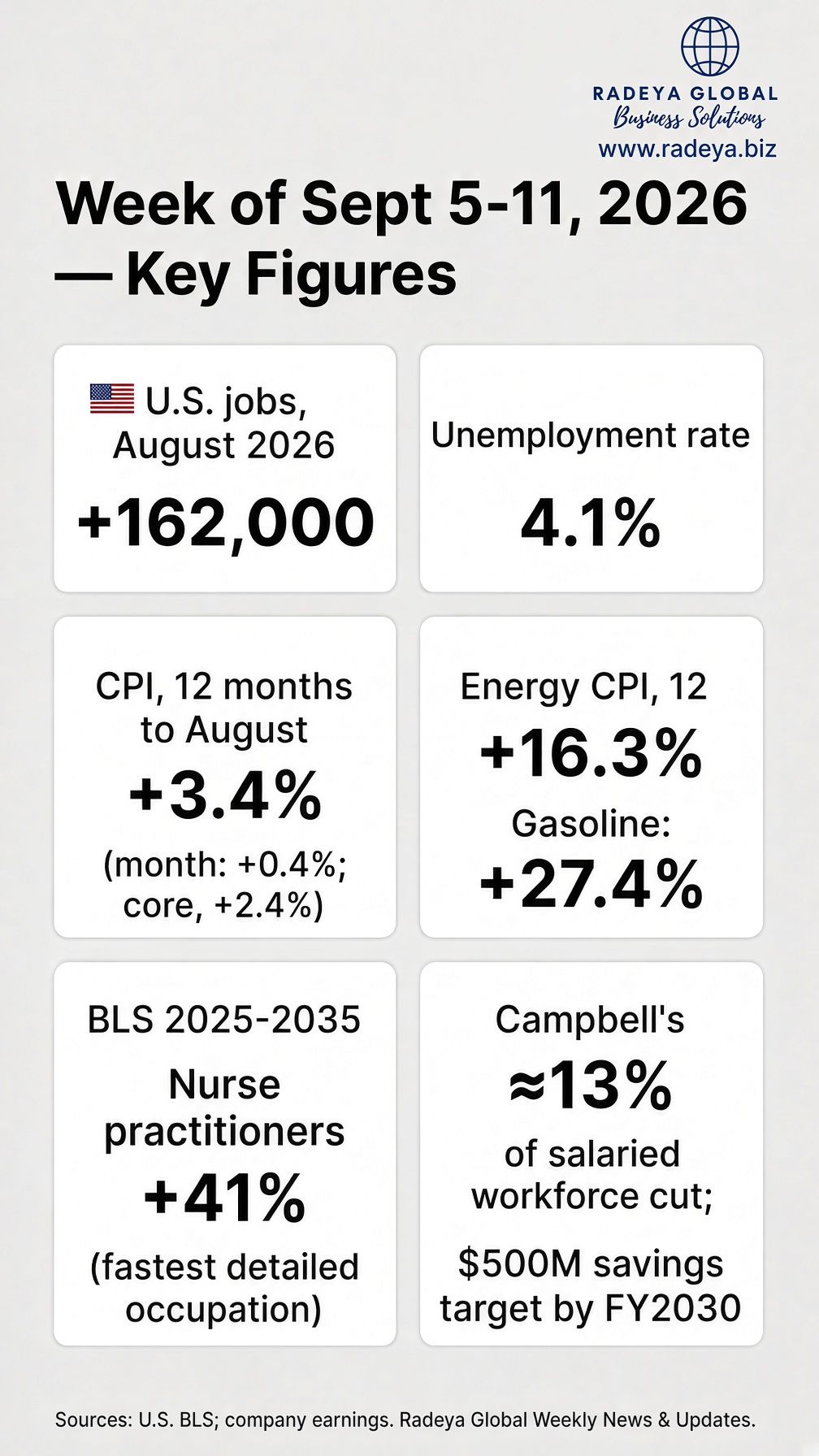
The longer-term map is even more useful for career planning. Fresh Bureau of Labor Statistics projections for 2025–2035 put nurse practitioners at the top of the fastest-growing occupations, with employment expected to rise about 41 percent. Solar installation, data science, wind-turbine technicians, medical and health services managers, and several therapy-support roles sit close behind. Healthcare is not a side story. Over the past year it has accounted for a large share of net U.S. job growth, and BLS expects private healthcare and social assistance to add more jobs than any other major industry over the next decade.
That does not mean every application is easier. Large employers continue to flatten teams. This week Campbell’s confirmed it had cut roughly 13 percent of its salaried workforce — more than 550 roles — and closed two snack plants, as part of a plan to save $500 million by fiscal 2030 after a weak quarter and softer snack demand. The pattern is familiar: consumer brands under margin pressure reduce layers first, then ask remaining managers to do more with fewer people.
Policy talk also returned to the length of the workweek. A renewed push for a 32-hour week, framed around AI productivity, met sharp pushback from business groups who argue it would raise costs and shrink hiring. For job seekers, the practical takeaway is simpler than the politics: employers are still paying for output, coverage, and scarce skills — not for a shorter week as a default.
AI, Big Tech, and the Future of Work
AI remains the organizing force behind both hiring and cuts.
Cloud and infrastructure names moved markets after Oracle reported stronger profit and revenue, with demand for AI training and inference still running ahead of supply. Hardware and server-related stocks followed. That is a career signal as much as a stock-market one: companies are still funding compute, data-center operations, implementation, security, and the operators who keep those systems running.
At the same time, AI is blurring job titles. More postings now ask for “AI literacy” even when the day-to-day work is still sales, operations, finance, or marketing. Financial Times coverage this week captured the other side of that shift: teams stepping on each other’s toes as tools let one function do work that used to sit in another. Graduates are not all locked out — some employers still cannot find work-ready junior talent — but entry-level roles that are mostly document processing, first-pass research, or generic coordination are the ones most exposed.
Closer to home, GITEX Ai Türkiye closed in Istanbul on 10 September after two days at the Istanbul Expo Center. Investors, startups, and global vendors used the inaugural edition to test where capital, compute, and talent will meet next in Türkiye and the wider region. For professionals in Istanbul and across Eurasia, the message is consistent with what we wrote earlier this week: AI investment is no longer only a Silicon Valley story. Local implementation, language, regulation, and industry knowledge are becoming hireable skills.
Recruiters and candidates should also stay alert to a less glamorous trend: a tight, uneven market is fertile ground for recruitment scams. If an “offer” asks for fees, personal banking details, or unpaid “onboarding tasks” before a real contract, walk away.
Broader Business & Economy
Friday’s inflation report was the week’s hinge.
U.S. consumer prices rose 0.4 percent in August and 3.4 percent over the past year — the same annual rate as July. Core inflation (excluding food and energy) was 2.4 percent over the year. Energy did the heavy lifting: the energy index was up 16.3 percent year over year, with gasoline up 27.4 percent. Shelter rose again after two softer months. That combination pushed market odds of a Federal Reserve rate increase at next week’s 15–16 September meeting sharply higher.
Stocks still finished Friday firmer as oil prices eased from intraweek peaks and investors treated a hike as more certain, if unwelcome. For executives, the operating picture is straightforward: borrowing costs may stay high or move higher; energy and logistics costs remain volatile; and consumers are trading down in packaged food and discretionary categories — which is exactly the pressure showing up in CPG restructuring.
Apple’s product week added another demand signal at the high end of consumer tech, including a first foldable iPhone at a premium price. That does not change the labor market overnight. It does remind hiring managers that product cycles and AI roadmaps still compete for budget with wages.
What This Means for You
- Treat hiring as sector-specific, not “the market is open.” Healthcare delivery and management, data and AI implementation, skilled trades around energy and infrastructure, and operators who can show cost or process results are still in demand. Generic mid-layer coordination roles are not.
- If you are job searching, lead with proof. Keyword-aligned profiles matter because screening is automated. Pair that with recent, measurable work: a process improved, a system deployed, a team outcome, a cost or time saved.
- If you are an executive, plan for tighter money and thinner teams. Rate-hike odds rose this week. That usually means slower headcount approval, more scrutiny on contractors, and a premium on people who can implement AI inside a real workflow rather than talk about it.
- Build practical AI skill, not a slogan. Tool evaluation, workflow design, quality control, and the ability to explain a business result will outlast any single platform name.
- In Türkiye and the wider region, stay close to the AI-investment conversation. GITEX’s first Istanbul edition is a reminder that local talent who can connect global tools to regional markets have a window — if they can show commercial outcomes, not only certificates.
- Protect your search. Confirm employers independently. Do not pay to “unlock” an offer.
Stay focused, keep building relevant skills, and position yourself for the opportunities these shifts create. We’ll be back next week with the latest insights.
At Radeya Global we help professionals and businesses turn these market signals into practical advantages — through targeted career strategy, resume and profile optimization, interview preparation, and custom business advisory support.
Ready to take action? Explore our career optimization and job search services, or reach out for business consulting support. You can also email us at services@radeya.biz or visit www.radeya.biz.
What career or business challenge are you navigating right now? Share in the comments or get in touch — let’s turn insights into progress together.
Radeya Global – Premium Business & Career Solutions.