The Rate Hike Lands, Tech Cuts Deepen, and AI Leaders Call for a Pause
By Kokab Rahman, Founder & CEO, Radeya Global
Welcome back to the Weekly News & Updates section on the Radeya Global Blog. Each week we distill the most relevant career and business developments so professionals, entrepreneurs, and job seekers can stay informed and act with clarity.
Here is what mattered this week (September 12–18, 2026).
Labor Market & Jobs
The U.S. labor market is still a low-hire, low-fire market — and this week’s data reinforced that pattern.
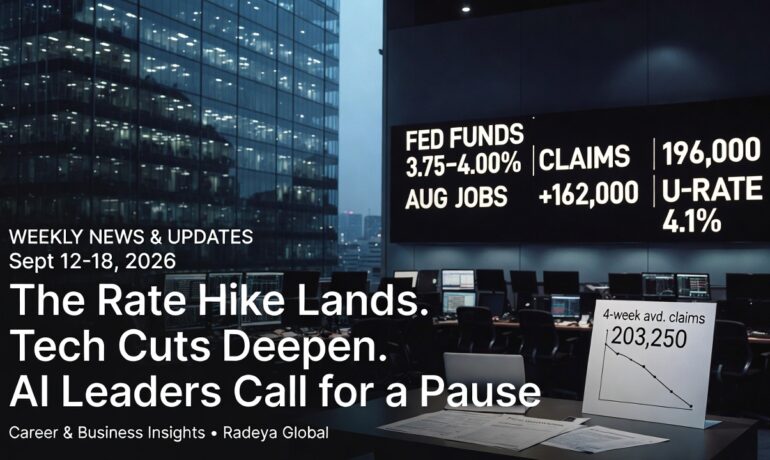
Initial claims for unemployment benefits fell to 196,000 for the week ended September 12, the lowest level since mid-July and below the 207,500 economists expected. The four-week average dropped to 203,250. Continuing claims, a rough proxy for how quickly people find new work, fell to 1.73 million. Layoffs remain sparse. Hiring remains modest.
That combination is the story for job seekers. People who already have roles are relatively secure. People who are searching still face a market that is open in some sectors and tight in others. August’s 162,000 payroll gain and 4.1 percent unemployment rate remain the latest official monthly snapshot. Average monthly job creation so far in 2026 is running near 80,000 — better than the weak 2025 pace, still well below 2023–2024.
Healthcare delivery, construction tied to energy and data-center buildouts, and roles that implement AI inside a real workflow continue to show demand. Information and many mid-layer coordination jobs do not. Large employers are still flattening teams even while they spend on compute.
AI, Big Tech, and the Future of Work
Two signals collided this week: companies kept cutting people to fund AI infrastructure, and several frontier-lab CEOs asked the industry to slow the next leap in model capability.
Oracle began another layoff round on Monday, September 14. Affected employees lost system access in the early hours and received termination notices around 6 a.m. The company has already disclosed about 21,000 job cuts over the past year. It also raised expected fiscal 2026 restructuring costs by about $700 million, to roughly $2.8 billion, while first-quarter capital expenditure hit $28.5 billion as it builds AI data centers.
The wider tally remains heavy. Trackers put global tech job cuts above 128,000 across nearly 300 companies by September 10. Uber’s plan to eliminate about 3,300 roles — roughly 10 percent of staff — is still moving. PayPal added headquarters cuts this week and restated a multi-year plan to reduce headcount by about 20 percent as it funds AI. Microsoft has been linked to further reductions in sales, consulting, and Xbox. Restructuring, duplicate teams, and cost discipline sit alongside AI as stated reasons. Automation is not the only explanation — but it is the budget priority.
Over the weekend, Anthropic CEO Dario Amodei published an essay calling on the industry to pace frontier development. OpenAI CEO Sam Altman, xAI’s Elon Musk, and Google DeepMind’s Demis Hassabis publicly aligned with the caution. Markets sold AI-linked stocks on Monday: Nvidia fell about 3 percent, and the broader chip complex dropped more. Anthropic said it would not go public this year. Altman called this an “ill-advised moment” for an OpenAI listing.
That debate matters for careers even if no formal pause arrives. Safety review, evaluation, governance, energy, and implementation roles become more valuable when the industry argues about control. Pure “AI hype” titles do not.
Two operational moves fit the same picture. On September 14, Microsoft published a draft code of conduct for AI systems: accept correction, comply with shutdown requests, and explain behavior in plain language. On September 16, Google, Nvidia, Emerald AI, Anthropic, and several utilities launched the AI Energy Management Alliance, promoting demand-response tools that could free grid room for more data centers — up to 100 gigawatts in the group’s long-run claim. Compute is still expanding. Headcount is not expanding with it.
Employer demand for AI skills in job postings has more than doubled over the past year. The premium is not on naming a model. It is on workflow design, quality control, domain knowledge, and the ability to show a business result.
Broader Business & Economy
The Federal Reserve delivered the hike markets had been watching.
On September 16, the FOMC voted 12–0 to raise the federal funds target range by 25 basis points, to 3.75–4.00 percent — the first increase since 2023. Chair Kevin Warsh said officials were not yet confident that underlying inflation was moving to target clearly and fast enough. The statement was blunt: inflation remains elevated; the action is meant to support a timelier return to 2 percent.
Updated projections put 2026 real GDP near 2.3 percent and the unemployment rate near 4.1 percent. Most officials penciled in at least one additional hike this year. The 10-year Treasury yield moved above 5 percent around the same window. For executives, that usually means slower headcount approval, tighter contractor budgets, and more pressure to fund AI and infrastructure from existing payroll.
August CPI, released just before this week opened, still frames the decision: consumer prices were up 0.4 percent on the month and 3.4 percent over the year. Core inflation was 2.4 percent over the year. Energy remains the loud item — up 16.3 percent year over year, with gasoline up 27.4 percent. Housing data this week was mixed: single-family starts rose 7.6 percent in August, while building permits slipped 1.8 percent.
Tighter money plus elevated energy costs is a cost-control environment, not a hiring boom.
What This Means for You
- Treat the labor market as sector-specific. Healthcare operations, infrastructure around power and data centers, skilled trades, and people who can deploy AI inside a measured process still have a path. Generic coordinator and middle-management titles remain under pressure.
- If you are job searching, lead with proof. Automated screening is the first gate. Pair keyword-aligned profiles with recent, measurable work: a process improved, a system shipped, a cost or cycle time reduced, a risk controlled.
- If you are an executive, plan for a higher-for-longer funding cost and thinner teams. The September hike, and the signal of another possible move this year, will slow open-req approvals. Spend will keep flowing to compute, energy, and implementation — not to extra layers.
- Do not wait for an “AI pause” to decide your skill plan. Even if frontier labs slow the next model jump, current tools stay in production. Evaluation, governance, energy-aware operations, and workflow redesign are the durable skills.
- In Türkiye and the wider region, the post-GITEX conversation is still about talent, capital, and compute. Local professionals who can connect global tools to regional markets and regulated industries have a window — if they can show commercial outcomes, not only certificates.
- Protect your search. Confirm employers independently. Do not pay to “unlock” an offer.
Stay focused, keep building relevant skills, and position yourself for the opportunities these shifts create. We’ll be back next week with the latest insights.
At Radeya Global we help professionals and businesses turn these market signals into practical advantages — through targeted career strategy, resume and profile optimization, interview preparation, and custom business advisory support. Ready to take action? Explore our career optimization and job search services, or reach out for business consulting support. You can also email us at services@radeya.biz or visit www.radeya.biz.
What career or business challenge are you navigating right now? Share in the comments or get in touch — let’s turn insights into progress together.
Radeya Global – Premium Business & Career Solutions.